# Datadog vs AppDynamics: A Complete Comparison for 2026
Two companies chased the same enterprise APM dollar for over a decade and ended up in almost opposite places. Datadog stayed independent, went public in 2019, and spent the years since bolting on every adjacent category it could reach, security, RUM, CI visibility, until "APM vendor" stopped being an accurate description of what it sells. AppDynamics sold to Cisco in January 2017, days before its own planned IPO, and then got folded a second time into Splunk after Cisco acquired Splunk in 2024. The product now goes by **Splunk AppDynamics**, and it sits inside a portfolio where its own parent company sells a direct competitor, Splunk Observability Cloud, explicitly positioned for the cloud-native workloads AppDynamics increasingly doesn't chase.
That corporate history matters more than a feature table here, because it answers the question everyone evaluating AppDynamics in 2026 eventually has to ask: **how much product investment does a platform get when the company that owns it also sells something newer aimed at the same buyer?** Splunk's own guidance nudges cloud-native teams toward Observability Cloud and leaves AppDynamics doing what it's always done best: deep, agent-based APM for the three-tier Java and .NET estates, the SAP landscapes, and the on-premises deployments that Datadog, SaaS-only, simply cannot serve.
That last point is the whole ballgame for some buyers. **Datadog has built the broadest integrated observability-and-security platform in this entire comparison series, Cloud SIEM, Continuous Profiler, Dynamic Instrumentation, Bits AI SRE, all genuinely excellent**, but it runs exclusively in Datadog's cloud. AppDynamics still ships a supported on-premises deployment and a concept, the business transaction, tied to Business iQ's revenue correlation, that Datadog has no direct equivalent for. Neither platform is obviously right; they're built for different estates and different procurement realities, and this comparison treats both seriously.
## Quick comparison at a glance
| Feature | Datadog | Splunk AppDynamics |
|---|---|---|
| **Primary purpose** | Full-stack observability + security platform | Enterprise APM with business context |
| **Ownership** | Independent, public | Cisco, via Splunk (since 2024) |
| **Free tier** | No (paid trial only) | Trial only |
| **Deployment** | SaaS only | SaaS + on-premises (self-hosted) |
| **Pricing model** | Per-host + per-GB + per-feature | Per-CPU-core editions (contact sales) |
| **High-water mark billing** | Yes (peak-of-month host count) | No (core-based licensing) |
| **APM instrumentation** | Proprietary DD Agent (OTel = custom metrics) | Proprietary agents (OTel secondary) |
| **Business transaction monitoring** | No | Yes (core concept, Business iQ) |
| **Code-level profiling** | Yes (Continuous Profiler) | Yes (deep for Java/.NET) |
| **Dynamic Instrumentation** | Yes | No |
| **Log management** | Two-tier ($0.10/GB + $1.70/M indexed) | Via Splunk platform (separate license) |
| **Infrastructure monitoring** | Yes (deep, per-host, incl. NPM) | Server Visibility (add-on, APM-scoped) |
| **SAP monitoring** | No | Yes (dedicated offering) |
| **Session replay** | Yes | Yes (add-on) |
| **Cloud SIEM / security** | Yes (extensive: SIEM, CSPM, CIEM, workload protection) | No (Splunk Enterprise Security, separate product) |
| **AI capabilities** | Bits AI SRE (GA Dec 2025, autonomous) | Cognition Engine (anomaly detection) + Splunk AI |
| **MCP server** | Yes (Preview) | No |
| **On-call / status pages** | Via Datadog On-Call or external | Via Splunk On-Call (separate SKU) |
| **SOC 2 Type II** | Yes | Yes |
| **HIPAA** | Yes | Yes |
| **FedRAMP** | Yes (GovCloud) | Yes (via Cisco/Splunk GovCloud) |
---
## Platform architecture and philosophy
The two products organize the world around different units of measurement entirely, and the corporate history behind each explains why.
### Datadog: one agent, one proprietary backend, breadth as the whole strategy

Datadog's model is integration as the product: install one agent, and data from a Kubernetes pod, a database query, a browser session, and a security alert all land in the same system, correlated automatically because Datadog controls the entire pipeline. That breadth is real and it's Datadog's defining strength across this whole series. The cost compounds the same way it does everywhere Datadog appears: infrastructure at $15-23/host/month is the foundation every other product stacks on top of, APM adds another $31-40/host/month, logs split into ingestion and indexing fees, and OpenTelemetry instrumentation gets billed as custom metrics rather than treated as a first-class native format.
### AppDynamics: the business transaction as the atom, agents as the product

AppDynamics built its architecture around a unit nobody else in this series makes central: the **business transaction**, a named flow like "checkout" or "loan application" that agents discover and track automatically, with health rules and learned baselines per transaction and Business iQ tying performance directly to revenue impact. It's a genuinely differentiated framing for organizations where engineering has to justify itself to a business audience, and it's the reason long-time AppDynamics customers stay.
The tradeoff is total commitment to proprietary agents: OTel exists but is secondary, and the whole data model is shaped around business transactions rather than open spans. **The one structural advantage no amount of Datadog's breadth changes: a supported on-premises deployment.** For defense, banking, and government environments where telemetry cannot leave the building, that's not a preference, it's a hard gate, and Datadog, SaaS-only, doesn't get through it at any price.
| Architectural factor | Datadog | Splunk AppDynamics |
|---|---|---|
| Core unit | Correlated telemetry across products | The business transaction |
| Instrumentation | Proprietary DD Agent (OTel = custom metrics) | Proprietary agents (OTel secondary) |
| Business impact correlation | No | Yes (Business iQ) |
| Deployment | SaaS only | SaaS + on-premises |
| Topology | Service maps (automatic) | Flow map (automatic, transaction-centric) |
| Roadmap ownership | Independent | Inside Splunk portfolio, alongside a competing product |
[summary]
### Neither platform closes the loop from alert to response
Both find the problem and hand off. Neither includes built-in on-call scheduling with phone and SMS delivery or customer-facing status pages without extra products. Better Stack brings observability and incident response together in one platform.
**From heartbeat monitoring to incident timelines to status pages, one platform for the whole reliability lifecycle.** [Start free.](https://betterstack.com)
[/summary]
---
## APM and distributed tracing
Both companies built their reputations here, and both remain genuinely strong, but the depth lives in different places.
### Datadog: the most feature-complete APM tooling in this comparison series
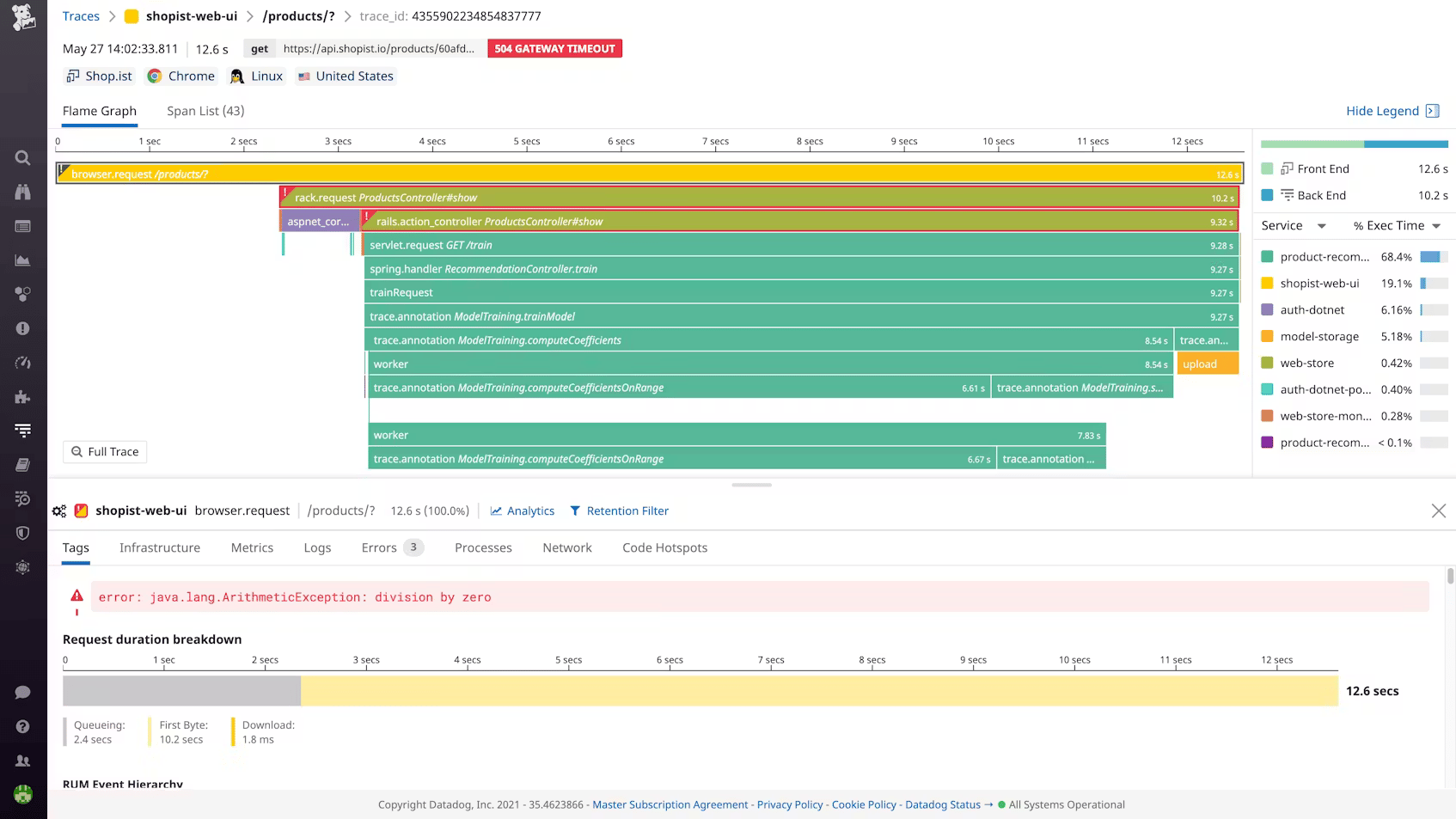
Datadog APM covers service maps, Continuous Profiler for code-level CPU and memory attribution, Dynamic Instrumentation for adding log lines to production without redeploying, and Watchdog for automatic anomaly detection, tooling depth that goes beyond what AppDynamics offers in the modern cloud-native direction. The cost: $31-40/host/month on top of infrastructure, with span limits high-throughput services routinely exceed, and OpenTelemetry instrumentation triggering the custom metrics surcharge that shows up throughout this series.
### AppDynamics: deep agents and business context, aging at the modern edges

AppDynamics agents remain genuinely deep for the platforms they were built for: Java and .NET instrumentation to the code level with automatic call graphs and baselining, and the business transaction framing answers "which user-facing flow is hurting" rather than just "which service is slow," a question Datadog's service-centric model doesn't ask the same way. For monolithic and three-tier applications, this is still one of the best tools available. The strain shows exactly where Datadog is strongest: OpenTelemetry is bolted on rather than native, cloud-native and serverless coverage lags, and the UI hasn't had the modernization pass Datadog's has.
| APM / tracing | Datadog | Splunk AppDynamics |
|---|---|---|
| Instrumentation | Proprietary DD Agent (OTel = custom metrics) | Proprietary agents (OTel secondary) |
| Code-level profiling | Yes (Continuous Profiler) | Yes (particularly deep for Java/.NET) |
| Dynamic Instrumentation | Yes | No |
| Business transaction framing | No | Yes (core differentiator) |
| Cloud-native / serverless | Strong | Weaker (steered to Observability Cloud) |
| APM pricing | $31-40/host/month (on top of infra) | Per-CPU-core (contact sales) |
[summary]
### APM without the per-host bill or the sales call for pricing
Datadog charges per host and AppDynamics won't quote a number without a sales conversation. Better Stack's tracing is priced purely by data volume with no span indexing fees and no cardinality penalties, and the AI SRE activates automatically during incidents to investigate root cause before you have to ask.
**Full-fidelity distributed tracing from every service, priced by volume with no surprises.** [Explore Better Stack tracing.](https://betterstack.com/tracing)
[/summary]
---
## Logs, infrastructure, and the platform question
This is where the comparison stops being APM vs APM and turns into platform vs portfolio, and it's the section that most exposes AppDynamics' position inside Splunk.
Datadog's logs run on the now-familiar two-tier model: $0.10/GB to ingest regardless of whether you search it, then $1.70 per million events to actually index and make searchable, with most teams ingesting everything and indexing selectively to manage cost. Infrastructure monitoring stacks on top at $15-23/host/month, with Network Performance Monitoring, a category AppDynamics doesn't offer at all, layered on further.
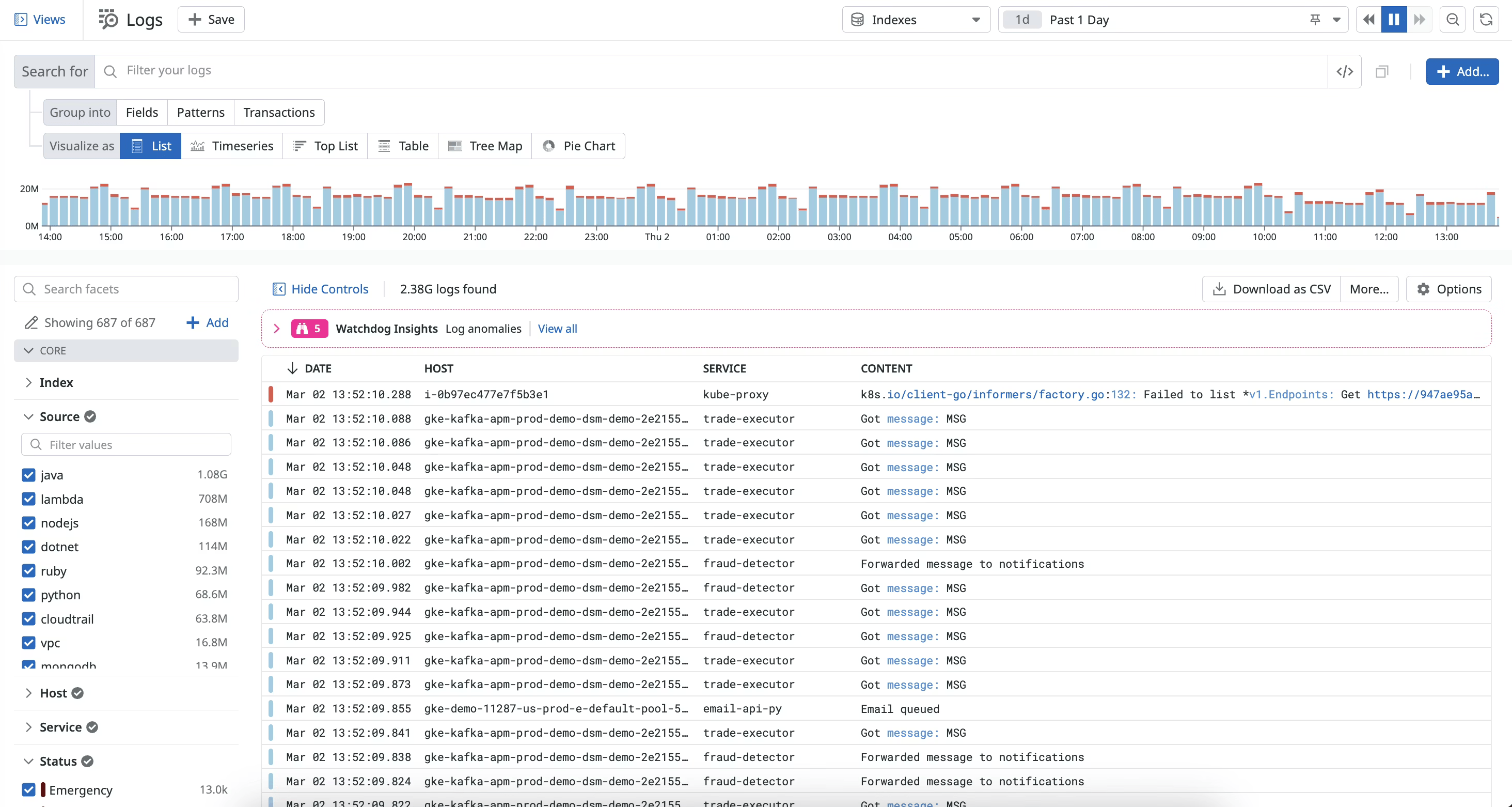
AppDynamics doesn't have a native log product at all. The answer is Splunk, genuinely the strongest log analytics platform in the industry, but a separate product with its own famously substantial pricing and its own license. Infrastructure monitoring in AppDynamics exists as Server Visibility, an add-on scoped to support APM investigation rather than a standalone infrastructure product the way Datadog's is.

The pattern that runs through this whole section: Datadog compounds cost by adding products inside one bill; AppDynamics compounds cost by requiring you to buy other Cisco/Splunk products entirely. Whether that's a problem depends on where you sit. An organization already running Splunk Enterprise for security gets a smoother path adding AppDynamics than it would adding Datadog from zero. A team starting fresh finds Datadog's single-vendor sprawl easier to reason about than assembling a Splunk portfolio.
| Capability | Datadog | Splunk AppDynamics |
|---|---|---|
| Log management | Native, two-tier billing | Via Splunk platform (separate license) |
| Infrastructure monitoring | Native, deep, includes NPM | Server Visibility add-on (APM-scoped) |
| Network Performance Monitoring | Yes | No |
| Cross-signal correlation | One vendor, multiple products | Across products, via integration |
| Products needed for full coverage | One (Datadog) | Several (AppDynamics + Splunk platform) |
[summary]
### Full-stack coverage without assembling a portfolio
Better Stack keeps logs, metrics, traces, uptime, and incident management in one warehouse with SQL querying and one volume-based bill, at $0.10/GB log ingestion with no per-query fees and no per-host or per-core math.
**Unified log management with SQL search, live tail, and no indexing surprises.** [See how it works.](https://betterstack.com/logs)
[/summary]
---
## Digital experience monitoring
Datadog's Digital Experience suite (Browser and Mobile RUM, Session Replay, Synthetic Monitoring, Product Analytics, Experiments) is mature and a two-time consecutive Gartner Magic Quadrant Leader, with frontend-to-backend correlation seamless because RUM and APM share the same backend.

AppDynamics offers browser and mobile RUM, session replay, and synthetic monitoring as End User Monitoring add-ons, and the business transaction correlation carries all the way through: a slow mobile interaction ties back to the backend flow and its revenue impact, something Datadog's RUM, however seamless technically, doesn't frame the same way.

The capability set is respectable on both sides; the investment trajectory is the real question. Datadog keeps shipping into this category aggressively. AppDynamics' RUM and synthetics energy inside Splunk visibly flows toward Observability Cloud instead, and neither company's analyst recognition currently favors AppDynamics here.
| Digital experience | Datadog | Splunk AppDynamics |
|---|---|---|
| Browser RUM | Yes (Gartner DEM Leader, 2x) | Yes (add-on) |
| Mobile RUM | Yes (iOS, Android, React Native, Flutter) | Yes |
| Session replay | Yes | Yes (add-on) |
| Synthetic monitoring | Yes | Yes |
| Product analytics / experiments | Yes | No |
| Business impact correlation | No | Yes (through Business iQ) |
---
## Security capabilities
This section resolves almost entirely in one direction, and it's worth stating plainly.
Datadog has built a substantial, genuinely differentiated security platform: Cloud SIEM for threat detection, Workload Protection for runtime kernel-level threats, App and API Protection, Code Security (SAST, IAST, SCA, secret scanning), CSPM, and CIEM, all correlated with the same observability data in one system. AppDynamics has no security product of its own at all. Whatever security capability an AppDynamics customer needs comes from Splunk Enterprise Security, a genuinely strong SIEM, but a completely separate product, separately licensed, on a different platform entirely, not integrated with AppDynamics telemetry the way Datadog's security signals are integrated with its own APM traces.
| Security | Datadog | Splunk AppDynamics |
|---|---|---|
| Cloud SIEM | Yes (native, correlated with APM) | No (Splunk Enterprise Security, separate) |
| Workload protection | Yes | No |
| Code security (SAST/IAST/SCA) | Yes | No |
| Integration with APM telemetry | Native, same platform | Requires separate Splunk product |
| SOC 2 Type II | Yes | Yes |
| FedRAMP | Yes (GovCloud) | Yes (via Cisco/Splunk) |
---
## AI capabilities
Bits AI SRE is GA and fires autonomously the moment an alert triggers. AppDynamics' AI story predates the LLM wave entirely and hasn't caught up yet.
### Datadog: Bits AI SRE, autonomous and shipping in production

Bits AI SRE went GA in December 2025 and investigates the moment an alert fires, without prompting: reading runbooks, chaining hypotheses across logs, metrics, and traces, often producing a root cause hypothesis by the time you reach your laptop. Around it sit Bits Chat, Bits Code, Bits Agent Builder, and Bits Security Analyst, all GA, plus an MCP server in Preview.
### AppDynamics: Cognition Engine, solid pre-LLM anomaly detection, then a gap
AppDynamics' Cognition Engine does anomaly detection against learned per-transaction baselines and automated root cause ranking, and for the stable, well-baselined enterprise apps AppDynamics targets, that machine learning genuinely works. What's missing is everything Bits AI SRE represents: no autonomous investigation agent, no MCP server, no natural language interface of its own. The generative AI roadmap runs through Splunk AI now, whose center of gravity is visibly the Splunk platform rather than AppDynamics specifically, which means AppDynamics' AI future depends on investment decisions it doesn't control.
| AI capability | Datadog | Splunk AppDynamics |
|---|---|---|
| Autonomous investigation | Yes (Bits AI SRE, GA Dec 2025) | No |
| Anomaly detection | Yes (Watchdog) | Yes (Cognition Engine, per-transaction baselines) |
| MCP server | Yes (Preview) | No |
| Natural language interface | Yes (Bits Chat, GA) | Via Splunk AI (platform-first, not AppDynamics-native) |
| AI code review | Yes (Bits Code, GA) | No |
[summary]
### AI investigation that ships today, connected to the response
Bits AI SRE is GA but still needs a separate paging tool, and AppDynamics has no autonomous agent at all. Better Stack's AI SRE activates autonomously during incidents and delivers its hypothesis into a live incident with the responder already paged, included in the platform.
**Autonomous root cause investigation connected to on-call, incidents, and status pages.** [See the AI SRE.](https://betterstack.com)
[/summary]
---
## Pricing comparison
Two models that fail in opposite directions: one compounds visibly across products you can see on a rate card, the other stays opaque until a sales call happens.
Datadog bills across independent dimensions that stack fast: infrastructure at $15-23/host/month, APM at another $31-40/host/month, logs split into $0.10/GB ingestion plus $1.70/million events indexed, custom metric surcharges beyond the per-host allotment, and high-water mark billing that sets your rate at peak host count for the month. A 100-host deployment with APM, logs, and RUM commonly runs $20,000-30,000/month.

AppDynamics prices per CPU core across editions, with the current rate card sitting entirely behind a sales conversation. Per-core licensing has a specific modern failure mode: a 32-core production host is 32 licensing units for the same application a 4-core VM ran a decade ago, and containerized environments where cores are shared make the counting genuinely contentious. Enterprise agreements discount heavily, especially riding a larger Cisco/Splunk contract, but there's no public number to sanity-check against, unlike Datadog's fully transparent, if compounding, rate card.
| Pricing factor | Datadog | Splunk AppDynamics |
|---|---|---|
| Price transparency | Full (public rate card) | Contact sales |
| Free tier | No (paid trial only) | Trial only |
| Cost anchored to | Host count + ingest + features | CPU cores + edition + add-ons |
| High-water mark billing | Yes | No (but core-density sensitive) |
| Self-serve start | Trial only | No |
| Enterprise bundling | Independent negotiation | Can ride Cisco/Splunk agreements |
[summary]
### Predictable neither way, and the response layer missing from both
Datadog's rate card is transparent but compounds fast, and AppDynamics won't give you a number without a sales call. Better Stack combines volume-priced logs, metrics, and traces with on-call scheduling, incident management, and status pages, one platform, one predictable bill.
**Fewer vendors, fewer context switches, and a single place for the full reliability workflow.** [Talk to us.](https://betterstack.com)
[/summary]
---
## What each platform genuinely lacks
**Datadog gaps worth knowing:**
1. No free tier; evaluation requires a paid trial.
2. High-water mark billing means traffic spikes affect your bill for the whole month.
3. OpenTelemetry metrics treated as custom metrics, a real penalty for teams following the open standard.
4. No business transaction monitoring or revenue-impact correlation comparable to Business iQ.
5. No on-premises deployment at any tier, which disqualifies it from air-gapped environments.
6. No SAP-specific monitoring offering.
7. No status pages, and on-call requires a seat-based add-on or external tool.
**Splunk AppDynamics gaps worth knowing:**
1. Roadmap uncertainty: it lives beside a competing product owned by the same parent, and Splunk's own positioning steers cloud-native buyers elsewhere.
2. No native security product of any kind; Splunk Enterprise Security is a separate license entirely.
3. No native log management; the answer is a separately licensed Splunk platform.
4. No autonomous AI investigation, no MCP server, no modern AI-assisted workflow of its own.
5. Opaque per-core pricing that requires a sales cycle to even estimate.
6. Weaker cloud-native and serverless coverage than every major competitor, including its own sibling product.
7. No free tier, no self-serve start.
---
## Final thoughts
The easier version of this decision applies to most buyers evaluating this pairing. If your estate is cloud-native, security operations and observability need to live in one procurement decision, and you want a fully transparent (if compounding) rate card, **Datadog's breadth wins this matchup clearly**. Cloud SIEM alone, correlated natively with the same APM traces, is a capability AppDynamics simply cannot offer at any price, because it doesn't own a security product.
The harder version is the one AppDynamics was actually built for and still serves well. If you run large Java and .NET estates, SAP landscapes, hybrid infrastructure with genuine on-premises requirements, and an organization that needs engineering performance translated directly into revenue language, **AppDynamics still does things nobody else in this comparison quite matches, and Business iQ is not a capability Datadog can replicate from its architecture**. If your company already has a Cisco or Splunk enterprise agreement, the commercial and operational path is meaningfully smoother than standing up Datadog from zero.
Go in aware of the trajectory question either way. Datadog controls its own roadmap completely and keeps shipping breadth aggressively across every category in this series. AppDynamics is two acquisitions deep, positioned by its own parent for the traditional half of the market while investment visibly flows to its cloud-native sibling. That doesn't make AppDynamics the wrong purchase for the right estate, mainframe-adjacent enterprise Java shops aren't going away, but it does mean you're buying for what the product does today with a clear-eyed view of who's deciding what it does next.
[summary]
### One thing neither covers: the full reliability layer
Neither Datadog nor Splunk AppDynamics includes uptime monitoring, on-call scheduling with phone and SMS, incident management, and customer-facing status pages as one unified product. Better Stack brings all of that together with logs, metrics, and traces, with usage-based pricing and no per-host, per-core, or high-water-mark surcharges.
**The full reliability lifecycle in one place. Start free, no credit card required.** [Try Better Stack.](https://betterstack.com)
[/summary]