# Better Stack vs Site24x7: A Complete Comparison for 2026
Site24x7 has been around since 2010 and has built a genuinely broad monitoring platform under ManageEngine (a division of Zoho). It **covers website monitoring, server monitoring, APM, network monitoring, log management, RUM, AIOps, and cloud cost management from a single subscription**. Thirteen thousand customers worldwide have adopted it. If you're an IT ops team managing mixed infrastructure (on-premises, cloud, network hardware, virtualized environments), Site24x7's depth is real.
**Better Stack takes a different bet: eBPF-based auto-instrumentation, a unified data warehouse where logs, metrics, and traces** are all queryable with the same SQL, and incident management built natively into the same platform. No agents per service, no per-feature billing, no cardinality penalties.
This comparison covers both platforms honestly. Site24x7 has genuine strengths. It also has architectural choices, a pricing structure, and notable gaps that matter depending on what you're running.
## Quick comparison at a glance
| Category | Better Stack | Site24x7 |
|---|---|---|
| **Deployment model** | eBPF collector (zero code changes) | Agent-based (per-host install) + APM SDKs per language |
| **Architecture** | Unified (logs, metrics, traces in one warehouse) | Multi-product (separate modules, each with own billing) |
| **Query language** | SQL + PromQL (universal) | Custom DSL varies by product |
| **Pricing model** | Data volume + responders | Per-monitor + per-host + per-resource add-ons |
| **OpenTelemetry** | Native, first-class | Supported via Prometheus/StatsD integrations |
| **Integrations** | 100+ covering all major stacks: MCP, OpenTelemetry, Vector, Prometheus, Kubernetes, Docker, PostgreSQL, MySQL, Redis, MongoDB, Nginx, and more | 300+ plugins, 130+ global monitoring locations |
| **AIOps** | AI SRE (autonomous incident investigation) | Causal AI, event correlation, anomaly detection (Enterprise plan) |
| **MCP server** | GA, all customers | Available via Zoho MCP (generally available) |
| **Network monitoring** | Not available | Comprehensive (SNMP, NCM, NetFlow, topology maps) |
| **MSP / multi-tenant** | Not a product focus | Native MSP plan |
| **Incident management** | Built-in (phone/SMS, on-call, escalations) | Third-party (PagerDuty, OpsGenie) or basic native alerting |
| **Status pages** | Included | Included (separate module, plan-tiered) |
| **Enterprise compliance** | SOC 2 Type II, GDPR | SOC 2 Type II, GDPR, ISO 27001 |
## Platform architecture
Site24x7 is an all-in-one platform in the sense that a single subscription covers many monitoring categories. But underneath, each category (APM, logs, RUM, network, infrastructure) is a distinct module with its own interface, its own retention policies, and its own add-on pricing. You switch between products during an investigation rather than staying in one view. Better Stack is unified in a different sense: one storage layer, one query interface, one correlation view.
### Better Stack: unified telemetry warehouse
Better Stack's architecture is built on eBPF-based collection, OpenTelemetry-native storage, and a single query interface across all signal types.
**eBPF collection** operates at the kernel level. Deploy one collector to your Kubernetes cluster and it automatically discovers services, instruments database calls (PostgreSQL, MySQL, Redis, MongoDB), and builds distributed traces. No code changes. No per-language SDK to manage.
**One warehouse, one query language.** All ingested data (logs, metrics, traces) lives in the same columnar store and is queryable via SQL or PromQL. When an alert fires, you see the service map, related logs, metric anomalies, and trace examples in a single view. No context switching between products.
**OpenTelemetry-native.** Instrumentation data stays in OTel format, meaning you own your data and your instrumentation. Changing destinations is a configuration change, not a migration project.

### Site24x7: agent-based multi-module platform
Site24x7 installs a lightweight agent on each monitored host, which handles infrastructure metrics and log collection. APM (called APM Insight) requires separate language-specific agents for Java, .NET, Python, PHP, Ruby on Rails, and Node.js. Network monitoring runs through on-premises pollers. Each product module has its own dashboard section.
What Site24x7 genuinely does well architecturally: **breadth**. No other platform in this price range covers network device monitoring (SNMP, NCM, NetFlow), OCI and VMware virtualization monitoring, and multi-cloud AWS/Azure/GCP monitoring at the level of detail Site24x7 provides. If you're an IT ops team managing Cisco switches alongside Kubernetes clusters, this breadth matters.
Where the architecture creates friction: investigations that cross product boundaries require navigation between the Infrastructure, APM, Logs, and RUM sections. Each has its own query interface, and correlating a frontend issue with a backend trace means manually reconstructing context that Better Stack surfaces automatically.

| Architecture aspect | Better Stack | Site24x7 |
|---|---|---|
| **Data collection** | eBPF (kernel-level, zero code) | Per-host agent + language SDKs for APM |
| **Storage model** | Unified (all signals in one warehouse) | Separate backends per product module |
| **Query language** | SQL + PromQL (universal) | Product-specific query interfaces |
| **Investigation flow** | Single view, all context present | Navigate between Infrastructure, APM, Logs, RUM |
| **OpenTelemetry** | Native, included | Via Prometheus/StatsD exporters |
| **Network monitoring** | Not available | Deep (SNMP, NCM, NetFlow, topology) |
| **Time to first insights** | Minutes (eBPF auto-discovery) | Hours to days (per-service instrumentation) |
## Pricing comparison
Site24x7 pricing is additive: you start with a base plan (Lite, Professional, or Enterprise), then add monitors for servers, websites, applications, network components, and log ingestion as separate line items. Better Stack pricing is volumetric: you pay for data ingested and stored, plus responders for on-call. The cost profiles diverge significantly at scale.
### Better Stack: volume-based, no multipliers
Better Stack charges for data volume with no hidden per-feature charges.
**Pricing structure:**
- Logs: $0.10/GB ingestion + $0.05/GB/month retention
- Traces: $0.10/GB ingestion + $0.05/GB/month retention
- Metrics: $0.50/GB/month (no cardinality penalties)
- Error tracking: $0.000050 per exception
- Responders: $29/month (unlimited phone/SMS)
- Monitors: $0.21/month each
**100-host, 100-application deployment example: $791/month**
- Telemetry (2.5TB/month): $375
- 5 Responders: $145
- 100 Monitors: $21
- Error tracking (5M exceptions): $250
No cardinality penalties. No high-water mark billing. No indexing decisions.
### Site24x7: modular add-on pricing
Site24x7's published pricing starts low but grows with every additional resource type. The Professional plan at $42/month (annual) covers 5 servers, 1 application instance, 20 websites, 4 GB log ingestion, and 10 network components. Anything beyond these defaults requires add-ons.
**Published add-on pricing (Professional plan):**
- Additional server monitors: $25 per 10 hosts/month ($2.50/host)
- Additional application (APM) instances: $8/instance/month
- Additional network components: $11 per 10 components/month
- Log ingestion add-on: $3 per 10 GB (7-day retention), $12 per 10 GB (30-day retention)
- RUM page views: $25 per 500K page views/month
- Synthetic transaction runs: $8 per 10,000 runs/month
**100-host, 100-application deployment example (Professional plan, annual):**
- Base plan (5 servers, 1 app, 20 websites): $42
- Additional 95 servers (10 add-ons × $25): $250
- Additional 99 APM instances (99 × $8): $792
- Log ingestion (100GB, 30-day retention, 10 add-ons × $12): $120
- RUM (5M page views): $150
**Approximate total: ~$1,354/month**
For full-stack observability matching Better Stack's coverage (APM, logs, metrics, RUM, incident management), the gap widens further when you factor in: the Enterprise plan requirement for anomaly detection and event correlation (starting at $625/month); the need for external on-call tooling since Site24x7's native alerting lacks phone and SMS delivery; and synthetic monitoring costs.
Worth noting: Site24x7 does offer an ROI calculator and volume discounts at scale. The Enterprise plan starting at $625/month (annual) includes anomaly detection, event correlation, and infrastructure events that aren't available on Professional. For teams where network monitoring and IT automation are core requirements, that Enterprise price covers capabilities that Better Stack doesn't offer at all.
### Cost comparison: 3-year TCO
For a 100-host, 100-application deployment over 3 years:
| Category | Better Stack | Site24x7 (Pro + add-ons) |
|---|---|---|
| Platform (logs, metrics, traces) | $33,600 | ~$28,800 |
| APM / distributed tracing | Included | ~$28,800 |
| Incident management (on-call) | $5,220 | $0 (basic alerts only) or ~$21,600 (PagerDuty) |
| Error tracking | $9,000 | Not native |
| Engineering overhead | $0 | Moderate (per-service instrumentation) |
| **Total** | **~$47,820** | **~$58,000–$79,000** |
Site24x7 comes in cheaper than Datadog but more expensive than Better Stack once APM is included. If your deployment is primarily infrastructure and website monitoring without deep APM needs, Site24x7's lower per-server pricing is competitive.
## Application performance monitoring
Site24x7 calls its APM product "APM Insight." Better Stack calls its eBPF-based tracing simply [APM](https://betterstack.com/tracing). The fundamental difference: Better Stack captures traces at the kernel level without code changes; Site24x7 requires installing a language-specific agent in each application.
### Better Stack: eBPF-based tracing
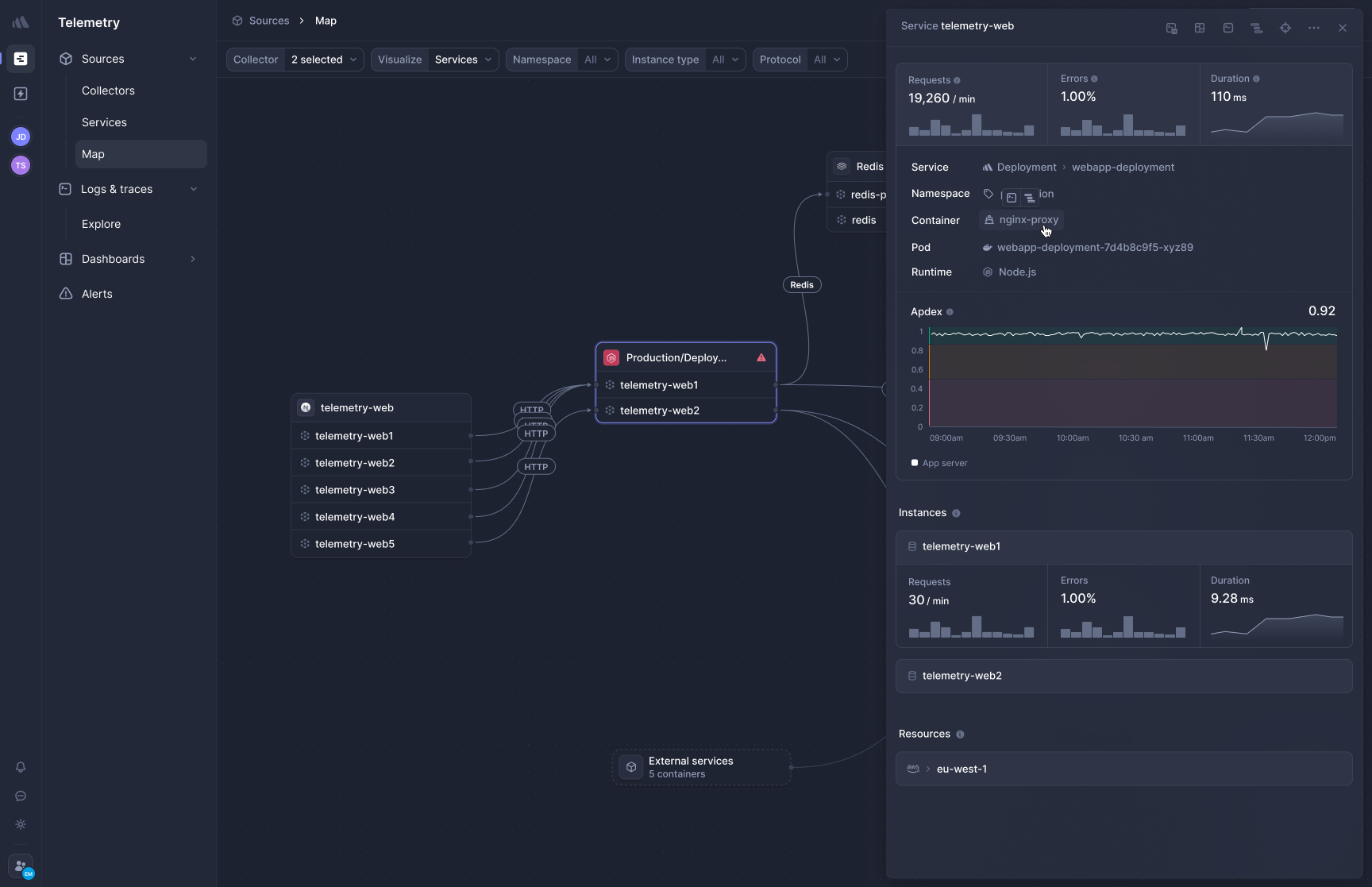
[Better Stack's APM](https://betterstack.com/tracing) deploys the eBPF collector once, and HTTP/gRPC traffic between services is captured immediately. Database queries are automatically traced.
**Frontend-to-backend correlation** is built into the same unified interface. A slow page load traces from the JavaScript error in the browser through your microservices and into the database query that caused it, all without switching products.
**Zero lock-in.** Because Better Stack stores traces in OTel format natively, your instrumentation isn't tied to a proprietary agent. Migrating destinations requires changing a config line, not rewriting your observability setup.
Polyglot environments (Python, Go, Java, Ruby, Node.js running side by side) benefit most from eBPF. Managing separate SDK versions per language, per service, is the kind of maintenance overhead that accumulates quietly until it starts slowing down shipping.
### Site24x7: APM Insight with deep code profiling
Site24x7 APM Insight supports Java, .NET, Python, PHP, Ruby on Rails, and Node.js via language-specific agents. Once instrumented, it provides code-level tracing, component tracing, distributed tracing, SQL query monitoring, service maps, and CPU/memory consumption per instance.
The Enterprise plan adds capabilities that Professional doesn't include: thread profiler and thread dump analyzer, JVM memory leak detection, transaction flow maps, deployment tracking, and code performance comparisons. If your team runs Java-heavy workloads and regularly investigates JVM-level memory issues, these capabilities are genuine differentiation.
**Honest limitation:** span retention is 7 days on Professional, 15 days on Enterprise. Better Stack's trace retention follows the same volume-based model as your logs, which typically means longer retention at lower cost.
**Sampling is required.** The Professional plan limits code-level tracing to 30 traces/minute with sampling. The Enterprise plan removes this limit. Sampling is a cost control mechanism that introduces the risk of missing the trace you need during a high-cardinality incident.

| APM feature | Better Stack | Site24x7 APM Insight |
|---|---|---|
| **Instrumentation** | eBPF (zero code changes) | SDK per service, per language |
| **Database tracing** | Automatic | Requires instrumentation setup |
| **Frontend-to-backend** | Unified (same SQL query, one interface) | RUM + APM correlation (both required) |
| **OpenTelemetry** | Native, no premium | Via Prometheus/StatsD exporters |
| **Code-level profiling** | Network-level | Deep (JVM leak detection, thread dumps) |
| **Span retention** | Volume-based (typically 30+ days) | 7 days (Pro), 15 days (Enterprise) |
| **Sampling** | No sampling decisions needed | Required for cost control on Professional |
## Log management
Both platforms collect logs. The difference is in searchability and pricing structure.
### Better Stack: all logs always searchable
[Better Stack logs](https://betterstack.com/logs) indexes 100% of ingested logs immediately. There's no decision to make about which logs matter before an incident starts.
Query logs, metrics, and traces together in the same SQL statement:
```sql
SELECT
service_name,
COUNT(*) as error_count,
AVG(duration_ms) as avg_duration
FROM logs
WHERE level = 'error'
AND timestamp > NOW() - INTERVAL '1 hour'
GROUP BY service_name
ORDER BY error_count DESC
```
**Pricing:** $0.10/GB ingestion + $0.05/GB/month retention. No indexing decisions, no rehydration delays.
### Site24x7: log management with tiered retention
Site24x7 supports 100+ out-of-the-box log formats. Its pricing is based on volume and retention period: $3 per 10 GB at 7-day retention, $12 per 10 GB at 30-day retention on the Professional plan. Log search alerts and dashboards are available across all plans.
The primary distinction from Better Stack is retention pricing: Site24x7 charges more per GB for longer retention, which can incentivize shorter retention windows as a cost control. Better Stack's flat $0.05/GB/month retention doesn't penalize longer storage in the same way.
Site24x7's minimum alert check frequency is 5 minutes on Professional and 3 minutes on Enterprise. Better Stack's alerting fires as soon as threshold conditions are met on the streaming data.

| Log management | Better Stack | Site24x7 |
|---|---|---|
| **All logs searchable** | Yes (100%, immediately) | Yes (all indexed logs, volume-based cost) |
| **Retention pricing** | Flat $0.05/GB/month | Tiered by retention window ($3–$12 per 10 GB) |
| **Query language** | SQL + PromQL | Custom DSL |
| **Trace correlation** | Automatic (same warehouse) | Via APM Insight (separate module) |
| **Log export** | Included | 100K/month (Pro), 1M/month (Enterprise) |
| **Minimum alert frequency** | Real-time | 5 min (Pro), 3 min (Enterprise) |
## Infrastructure monitoring and server monitoring
Site24x7's strongest category. Its server monitoring covers Windows, Linux, FreeBSD, Docker, Kubernetes, VMware, Nutanix, and Hyper-V. The 300+ plugin integrations allow custom metric collection from nearly anything running on a server. Cloud monitoring covers AWS, Azure, GCP, and OCI with continuous auto-discovery and auto-scale management. Network monitoring includes Layer 2 discovery, topology maps, SNMP trap collection, NetFlow analysis, and Network Configuration Management (NCM) with firmware vulnerability scanning and compliance checks.
Better Stack does not have network device monitoring. If SNMP, network topology, or NCM compliance is a requirement, this comparison ends here.
### Better Stack: metrics without cardinality anxiety
[Better Stack metrics](https://betterstack.com/infrastructure-monitoring) is Prometheus-compatible with full PromQL support and no cardinality-based billing.
High-cardinality tags (adding `customer_id`, `deployment_version`, `feature_flag`) cost nothing extra in Better Stack. The bill scales with storage volume, not with the number of unique time series.
### Site24x7: deep infrastructure with strong cloud coverage
Site24x7's infrastructure coverage is extensive. It monitors standard server metrics out of the box, supports plugin-based custom metrics collection, provides Kubernetes monitoring at 10 containers per host (with node-level pricing available), and integrates with StatsD and Prometheus exporters.
What genuinely stands out: continuous discovery for AWS, Azure, GCP, and OCI means new cloud resources get picked up automatically. Guidance Reports analyze cloud resources for availability, cost, and security best practices, a feature Better Stack doesn't have. The Lite plan's hourly pricing ($0.006/hour/VM) suits ephemeral cloud instances better than monthly per-host pricing.

| Infrastructure feature | Better Stack | Site24x7 |
|---|---|---|
| **Cardinality pricing** | None (volume-based) | Custom metrics vary by plugin; base metrics included |
| **Network devices** | Not available | Deep (SNMP, NCM, NetFlow, 10,000+ templates) |
| **VMware / Nutanix** | Not available | Full support |
| **Cloud guidance reports** | Not available | Available (cost, availability, security practices) |
| **Kubernetes** | eBPF auto-discovery | 10 containers per host (add-on pricing) |
| **PromQL / Prometheus** | Native | Via Prometheus exporter integration |
| **Hourly billing** | Not available | Yes ($0.006/VM/hr) |
## AIOps and MCP
Both platforms launched significant AI features in early 2026. The approaches differ in meaningful ways.
### Better Stack: AI SRE and production-ready MCP
Better Stack's **AI SRE** activates during incidents without requiring manual prompting. It analyzes the service map, queries logs for error patterns, checks recent deployments, and generates a root cause hypothesis before you've had a chance to type your first search.
The **[Better Stack MCP server](https://betterstack.com/docs/getting-started/integrations/mcp/)** is generally available to all customers. Connect Claude, Cursor, or any MCP-compatible AI assistant to your observability data:
```json
{
"mcpServers": {
"betterstack": {
"type": "http",
"url": "https://mcp.betterstack.com"
}
}
}
```
Your AI assistant can then query logs with ClickHouse SQL, check who's on-call, acknowledge incidents, review monitor status, and build dashboard charts through natural language. The MCP server covers the full Better Stack surface: uptime monitoring, incident management, log querying, metrics, dashboards, error tracking, and on-call scheduling. Access controls let you allowlist read-only tools or blocklist destructive operations.
### Site24x7: causal AI and Zoho MCP
In February 2026, ManageEngine announced significant AIOps upgrades to Site24x7: domain-aware causal correlation, customizable AI Agents with governance guardrails, and MCP-based agentic foundations. These are available on Professional and Enterprise plans.
The causal correlation is technically interesting: it correlates anomaly signals across applications, infrastructure, and network layers within a 10-minute window into a single problem view, distinguishing causation from correlation (for example, whether CPU caused latency or vice versa). Early customer reports from companies like Synechron cite 90% reductions in alert noise. That's a meaningful claim.
Site24x7's MCP integration is delivered via Zoho MCP, which acts as a gateway that exposes Site24x7 APIs as AI tools. You connect Claude, Cursor, or other MCP clients through Zoho MCP rather than through a direct Site24x7 endpoint. The capability is generally available and supports natural language queries against live monitoring data, IT automation triggers, and root cause correlation.
The distinction from Better Stack's MCP: Better Stack's MCP server connects directly to your observability data stack (logs, metrics, traces, incidents, on-call). Zoho MCP for Site24x7 focuses on monitoring commands, monitor group management, IT automation triggers, and telemetry access. Both are functional MCP integrations; the scope of what each surfaces differs.
Is your team already using Zoho products? If so, the Zoho MCP integration fits naturally into an existing Zoho ecosystem. If not, it adds an ecosystem dependency Better Stack avoids.

| AI capability | Better Stack | Site24x7 |
|---|---|---|
| **Autonomous incident AI** | AI SRE (activates during incidents) | Causal AI (available Pro/Enterprise) |
| **Causal correlation** | Via AI SRE analysis | Domain-aware causal correlation (Feb 2026) |
| **MCP server** | GA, direct endpoint, all customers | Via Zoho MCP, generally available |
| **Alert noise reduction** | Correlated through service map | 10-minute window correlation (90% noise reduction claimed) |
| **Governance / guardrails** | Allowlist/blocklist per tool | Configurable AI Agents with guardrails |
| **AI coding integration** | Claude Code + Cursor | Claude, Cursor, Windsurf, VS Code (via Zoho MCP) |
## Incident management
Site24x7 is a monitoring platform with alerting, not an incident management platform. Its native alerting covers thresholds, anomalies, forecasts, and composite conditions across all product modules. What it doesn't have natively: on-call scheduling, escalation policies, phone call delivery, and Slack-native incident channels. For those, most Site24x7 customers integrate PagerDuty or OpsGenie separately.
### Better Stack: built-in on-call and incident workflows
[Better Stack incident management](https://betterstack.com/incident-management) includes phone and SMS alerting, on-call scheduling, escalation policies, and Slack-native incident channels at $29/month per responder. Everything you'd otherwise pay separately for.
### Site24x7: alerting with third-party on-call
Site24x7 alerts on metrics, logs, APM traces, RUM events, network status, and cloud resources. It integrates with PagerDuty, OpsGenie, Slack, Microsoft Teams, and other notification channels. IT Automation lets you trigger scripts on alert firing (restart a service, clear disk space) directly from the platform, which is a meaningful capability for autonomous remediation.
What's missing: native phone/SMS delivery for on-call, rotation-aware scheduling, and automatic post-mortem generation. If you're running Site24x7 and PagerDuty together for 5 responders, you're spending $245-415/month on PagerDuty on top of Site24x7.

| Incident feature | Better Stack | Site24x7 |
|---|---|---|
| **On-call scheduling** | Built-in | Via PagerDuty/OpsGenie integration |
| **Phone / SMS alerts** | Unlimited (included, $29/responder) | Via third-party integration |
| **Escalation policies** | Native, multi-tier | Via third-party integration |
| **Incident Slack channels** | Automatic, native | Via Slack integration |
| **Post-mortems** | Automatic generation | Not native |
| **IT Automation** | Via integrations | Built-in (script execution on alert) |
| **Monthly cost (5 responders)** | $145 | $0 native + $245–415 PagerDuty |
## Website monitoring and synthetic transactions
This is Site24x7's original core capability and it remains a genuine strength. Site24x7 monitors from 130+ global locations, supports 1-minute polling on all paid plans (10 seconds on Enterprise), and includes multi-step transaction monitoring that records and replays real browser interactions. Video-based root cause analysis for web transactions (available on Enterprise) is a distinctive feature: when a transaction fails, you get a video playback of what happened.
Better Stack's website monitoring covers HTTP/HTTPS endpoint checks, keyword content validation, SSL/TLS certificate expiry, DNS, SMTP, FTP, and REST API checks. Its monitoring network is smaller than Site24x7's 130+ locations. Multi-step browser transaction recording is not a current Better Stack capability.
If your team's primary use case is synthetic transaction monitoring, API monitoring from global locations, and multi-step user journey simulation, Site24x7's Web Perf and Enterprise Plus Web plans are purpose-built for this. Better Stack doesn't match that specific capability depth.

## Real user monitoring
### Better Stack: unified RUM

Better Stack RUM captures Core Web Vitals (LCP, CLS, INP), session replays, JavaScript errors, and funnel analytics. Because it sits in the same data warehouse as backend telemetry, a session replay links directly to the backend traces and infrastructure metrics active during that session. No cross-product configuration required.
**Session replay** includes rage-click detection, dead-click filtering, and PII exclusion at the SDK level. **Website analytics** tracks referrers, UTM campaigns, entry/exit pages, and traffic sources including ChatGPT in real time. **Product analytics** with auto-captured events and funnel analysis requires no pre-instrumentation.
**Pricing:** $0.00150 per session replay, included in the same volume-based billing model as logs and metrics.
### Site24x7: RUM with AI-powered anomaly detection
Site24x7 RUM tracks page views, front-end performance, JavaScript errors, user sessions, single-page application monitoring, and geographic segmentation. The Enterprise plan adds AI-powered anomaly detection for RUM and full session replay capability. Session replay is not available on Lite or Professional plans.
The RUM-APM integration on Enterprise lets you click from a slow page load directly to the backend APM trace, which is valuable correlation. On Professional, this cross-product correlation requires manual effort.
Site24x7's RUM pricing: $25 per 500K page views (Professional plan add-on), $5/100K page views at the standalone rate. No session replay on lower plans is a notable limitation given that session replay is table stakes for frontend debugging.
**Mobile RUM**: Site24x7 RUM covers web applications. Mobile RUM requires a separate mobile APM product. Better Stack's RUM is currently web-focused; mobile is not a current offering on either platform in a comparable form.

| RUM feature | Better Stack | Site24x7 |
|---|---|---|
| **Session replay** | Included | Enterprise plan only |
| **Core Web Vitals** | LCP, CLS, INP | Available |
| **AI anomaly detection** | Via AI SRE | Enterprise plan |
| **Backend trace correlation** | Automatic (unified warehouse) | Requires APM + RUM setup (Enterprise) |
| **Product analytics / funnels** | Yes | Limited |
| **Website analytics (UTM, referrers)** | Yes | Not a focus |
| **Pricing (5M events)** | ~$7.50 (volume-based) | ~$150/month (add-on) |
## Cloud cost management
Site24x7 includes CloudSpend (available on all paid plans), which tracks multi-cloud spend across AWS, Azure, and GCP. It provides budget tracking, spend analysis by business unit, tag-based cost attribution, and recommendations for unused resources. Pricing is 1% of your cloud bill.
Better Stack does not have a cloud cost management product.
If cloud cost visibility is a primary requirement alongside observability, Site24x7's integrated CloudSpend removes the need for a separate tool like CloudHealth or Spot.io. This is genuine added value with no counterpart in Better Stack.
## Status pages and customer communication
### Better Stack: built-in, multi-channel
[Better Stack Status Pages](https://betterstack.com/status-pages) is included with incident management and syncs automatically with the incident timeline.
Public and private pages, custom domains, real-time incident updates, subscriber notifications via email, SMS, Slack, and webhook. Custom CSS, SAML SSO for private pages, scheduled maintenance announcements. Pricing: $12-208/month for advanced features.
### Site24x7: plan-tiered status pages
Site24x7 includes status pages on all paid plans: 3 pages on Lite/Web Uptime, 10 on Professional, 20 on Enterprise. Pages display component status, support custom domains, and integrate with the alerting system.
Email subscriptions are available for status page updates. SMS and Slack subscriber notifications are not included natively (Better Stack includes both). Status page subscriber management is more limited than Better Stack's multi-channel approach.
| Status pages | Better Stack | Site24x7 |
|---|---|---|
| **Availability** | Included with incident management | Included (3–20 pages depending on plan) |
| **Subscriber channels** | Email, SMS, Slack, webhook | Email only |
| **Custom branding + CSS** | Full control | Custom domains, component status |
| **Auto-sync with incidents** | Yes | Yes |
| **Private pages (SSO/IP)** | Yes | Internal authentication |
## Enterprise readiness
Both platforms are SOC 2 Type II and GDPR compliant. Site24x7 is hosted on ISO 27001-certified infrastructure and serves enterprise customers across financial services, healthcare, and government sectors. Better Stack offers data residency options (EU and US), optional self-hosted data via your own S3 bucket, and a dedicated Slack support channel with named account manager on enterprise plans.
Neither platform currently holds FedRAMP or HIPAA certification.
| Enterprise feature | Better Stack | Site24x7 |
|---|---|---|
| **SOC 2 Type II** | ✓ | ✓ |
| **GDPR** | ✓ | ✓ |
| **ISO 27001** | Data centers certified | ✓ (ManageEngine infrastructure) |
| **HIPAA** | ✗ | ✗ |
| **FedRAMP** | ✗ | ✗ |
| **SSO (SAML/OIDC)** | Okta, Azure, Google | SAML-based SSO (all plans) |
| **Biometric authentication** | ✗ | ✓ (all plans) |
| **SCIM provisioning** | ✓ | ✗ (not published) |
| **RBAC** | ✓ | ✓ (user limits by plan) |
| **Audit logs** | ✓ | ✓ |
| **Data residency** | EU + US, optional S3 bucket | Hosted; data center selection available |
| **Dedicated support channel** | Slack + account manager (Enterprise) | Classic support + sales contact |
| **SLA** | Enterprise SLA available | Enterprise SLA available |
| **MSP / multi-tenant** | Not available | Native MSP plan ($49–59/month) |
One genuine Site24x7 enterprise strength: SAML-based SSO and biometric authentication are available on all plans, including the $9/month Lite plan. Better Stack reserves SSO for higher plans. For small security-conscious teams, that's noteworthy.
## Final thoughts
For most engineering teams evaluating observability in 2026, **Better Stack** is the stronger pick. **You get logs, metrics, distributed traces, error tracking, real user monitoring, and incident management** in one unified platform, at a fraction of what comparable coverage costs elsewhere. The eBPF collector removes instrumentation overhead entirely. The MCP server connects Claude, Cursor, and other AI assistants directly to your observability data today, not in preview. And the pricing model (volume-based, no cardinality penalties, no span indexing fees) scales predictably as your infrastructure grows.
Site24x7 earns genuine consideration in three specific situations: your infrastructure includes **network hardware** (routers, switches, firewalls) that needs SNMP, NetFlow, or NCM coverage; you manage **on-premises virtualization** (VMware, Nutanix, Hyper-V) that needs deep visibility; or you operate as an **MSP** needing multi-tenant monitoring under one contract. These are real capabilities Better Stack doesn't have, and if they're core to your environment, they matter.
What Site24x7 doesn't change: the instrumentation overhead, the add-on pricing complexity, the missing native on-call stack, and the multi-product investigation flow that slows incident response. If your team is running cloud-native workloads and spending time managing tracing libraries, optimizing log retention windows, or paying separately for on-call tooling, those are signals the platform is working against you.
[Start your free trial](https://betterstack.com) or [compare pricing](https://betterstack.com/pricing) to see how much you could save.